
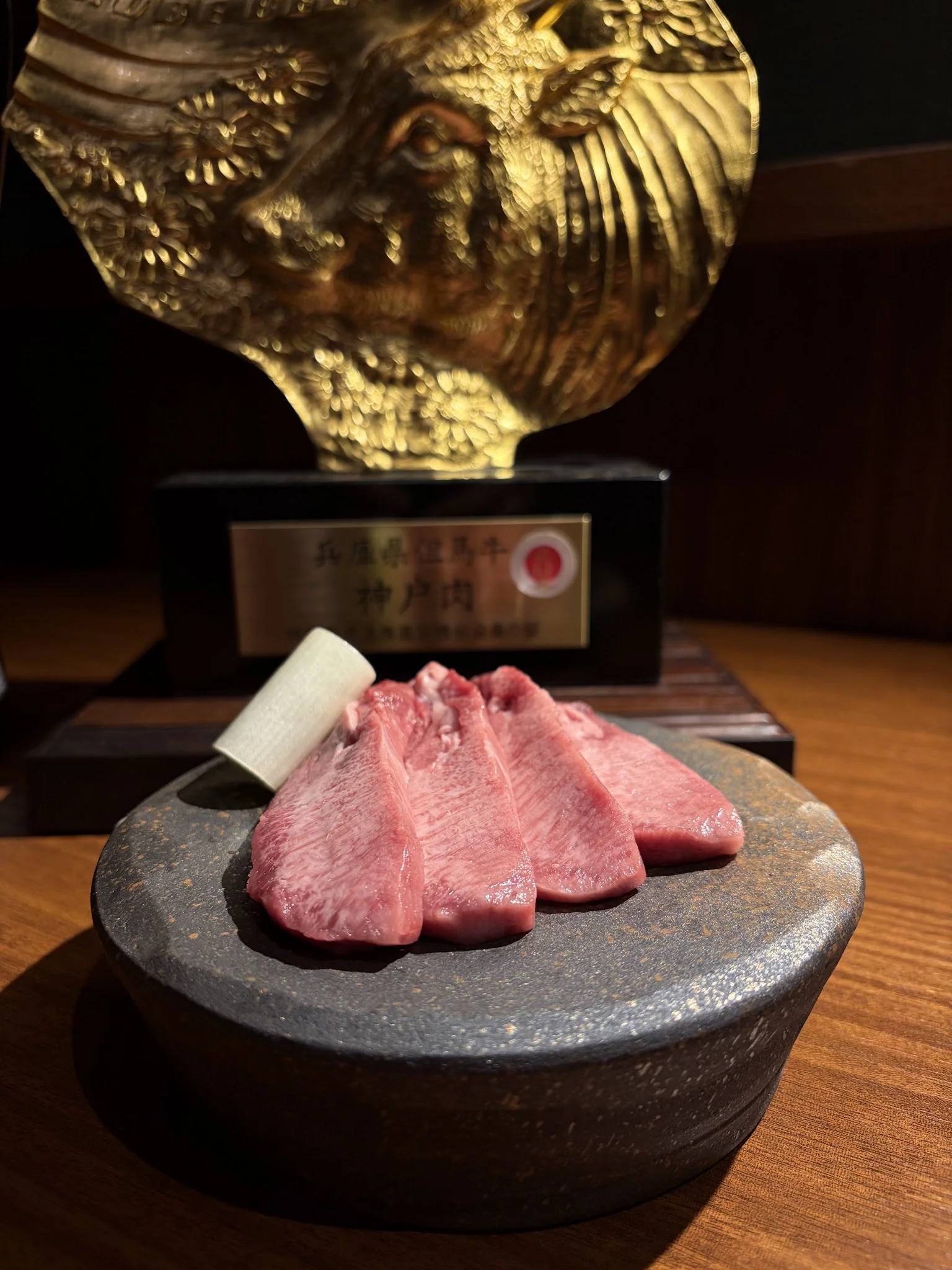
A tongue has a job to do
A grazing cow wraps its long tongue around grass and draws it against the lower front teeth and the hard pad above. The result is a muscular organ with a tip and a broader base rather than a uniform cylinder. At the butcher’s block, the tongue is trimmed and peeled before the direction and thickness of the slices are chosen.
A snap or a little spring?
Pick up a thin slice with the raw-meat tongs and its ends hang down; a thick piece holds its shape. At the table, a thin slice tends to part cleanly at the first bite, while a thick one lets you notice resistance and spring in the middle. Thickness, the part of the tongue and the way it is sliced all contribute to that difference.
Ordering tongue to suit the meal
The dinner menu has regular and thick-cut tongue, plus a separate Hirai Farm tongue in the farm selections. Share the regular and thick cuts if thickness is what interests you; compare farm tongue and cheek if you want to explore two muscles of the head. Next time you order, “I like a clean snap” is more useful than trying to remember a measurement in millimetres.